

Spiral Freezer Solutions that Boost Freezing Capacity and Reduce Energy Costs
2026-10-28
Every degree of inefficiency in your freezing line quietly erodes margins, especially as energy prices climb and peak-season capacity gets squeezed. Spiral freezers promise a compact answer, but most systems still force a choice between higher throughput and lower operating costs. That trade-off is no longer necessary. Worldbase designs spiral freezer solutions that expand freezing capacity while actively reducing energy consumption, helping processors meet demand spikes without watching utility bills spike. In this post, we will unpack how the right spiral freezer design changes the economics of freezing.
Making the Most of Tight Plant Floors with Vertical Spiral Freezers
Plant managers often see a cramped floor as a hard limit, but vertical spiral freezers turn that constraint into a layout advantage. Instead of sprawling across valuable square footage, these systems stack freezing capacity upward. A single vertical unit can replace a long tunnel freezer, freeing up ground-level space for prep stations, packing lines, or even additional storage. The real win is flexibility: you can tuck a spiral into a corner or against a wall where conventional equipment would never fit, and still hit your target throughput.
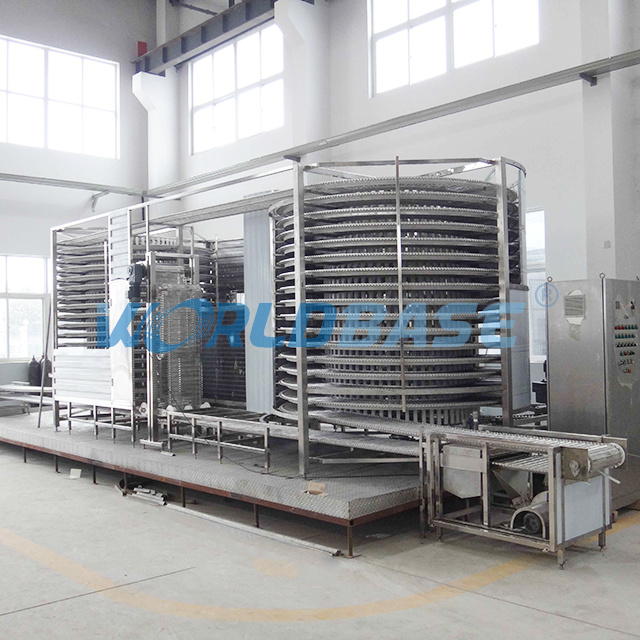
What makes vertical spirals particularly useful on tight floors is their small footprint relative to belt length. By winding the conveyor belt around a rotating drum in a compact helix, you get hundreds of meters of freezing dwell time in a cylinder that might occupy less than a tenth of the floor area of a linear tunnel. This means you can increase production without knocking down walls or renting off-site cold storage. Many operators also notice fewer bottlenecks at loading and unloading, since the infeed and outfeed can be positioned close together to match existing line flow.
The space savings go beyond just the machine itself. Vertical spirals often reduce the need for long transfer conveyors and complex routing, which cuts both installation cost and daily sanitation time. On a packed floor, every meter of conveyor you eliminate is a meter you can use for something else. Pair that with a smaller ammonia charge or lower refrigerant volume compared to some tunnel designs, and the equipment starts to look less like a compromise and more like the obvious choice for plants that simply cannot expand outward.
Airflow Tweaks That Speed Up Freezing Without Extra Compressor Load
Moving cold air where it matters often beats running the compressor harder. The first place to look is the gap between shelves and the back wall. If boxes or bins sit too close, they choke the return path and force the evaporator fan to work against a wall of trapped air. Pulling items forward by even an inch or two lets the cold discharge drop down the face of the load instead of curling back into the coil. In walk-in freezers, adding small clip-on air deflectors to the evaporator outlet pushes the air stream toward the center of the room, which shortens pull-down times on warm incoming stock.
Another overlooked fix is the fan delay setting. When the compressor shuts off, the evaporator fan keeps running for a short while to strip residual cooling from the coil. Too short a delay wastes that stored energy; too long can blow warm air after defrost. Dialing this to match the actual coil temperature drop gives you extra cooling at zero added load. Clean fan blades and an unobstructed drain line matter just as much, since a slight frost buildup on the blade tips can reduce airflow by 20 percent or more while the compressor still pulls the same amps.
Check the door gasket and pressure relief port as well. A freezer that breathes too easily through a worn gasket pulls moist air in, which turns to frost on the coil and restricts airflow within a day. A balanced relief port lets air leave without dragging humid outside air back through gaps. These adjustments don't touch the compressor curve, but they cut freezing time because the existing BTU removal is finally reaching the product instead of short-circuiting back to the coil.
Where Energy Actually Goes in a Spiral Freezer and How to Reclaim It
Most operators assume the refrigeration compressor uses the bulk of electricity in a spiral freezer, but in practice the evaporator fans are often the quiet energy sink. On older systems with fixed-speed AC fan motors running continuously, fans can consume 30–40% of the total freezer power even though they add heat that the refrigeration system then has to remove. Add in frequent timed defrost cycles, which may account for another 10–15% of energy use, and a poorly balanced air flow pattern that pulls warm, humid air into the enclosure, and a significant portion of the electrical input never goes into freezing product at all.
Reclaiming that wasted energy starts with measuring where it actually goes. Installing variable frequency drives on evaporator fans and lowering fan speed during low-production periods can cut fan energy by half or more without sacrificing freezing performance. Demand-based defrost—triggered by coil pressure drop or frost sensors rather than a fixed clock—reduces both the direct heat input from defrost and the subsequent cooling load. On the heat rejection side, recovering condenser heat to preheat washdown water or to warm adjacent packing areas turns a disposal problem into a usable resource, often with a payback under two years.
Beyond those, air management is the highest-leverage change for many spiral freezers. Tightening product lane openings, fixing damaged strips or curtains, and rebalancing supply and return air so the freezer operates slightly positive relative to the surrounding room can dramatically reduce frost accumulation and infiltration loads. Even small improvements in air balance reduce the need for defrost and let the compressors run fewer hours, which means reclaimed energy shows up directly on the utility bill.
The Defrost Cycle Trap: Wasted Kilowatts You Can Stop Paying For
Most refrigerators kick into defrost anywhere from two to four times a day, and each cycle can pull 400 to 700 watts while the heater is engaged. If a door gasket leaks or a defrost thermostat drifts out of spec, that schedule quietly stretches into longer or more frequent bursts. You won't hear it happening—there's no loud compressor roar—but the meter notices. A unit stuck in an aggressive defrost pattern can burn an extra 20 to 40 kilowatt-hours a month without a single visible symptom beyond slightly warmer crisper drawers or a faint clicking sound near the back panel.
The fix often costs less than one month of the waste. Start by logging how many times the heater fires over a 24-hour period; a plug-in power meter or an energy monitor with a data log makes this straightforward. Then check the magnetic door gasket with a dollar bill—if it slides out easily, replace the seal. If the defrost thermostat tests open or closed at the wrong temperature, swap it. Finally, avoid loading warm, uncovered food near the evaporator fan, since added moisture forces the system into extra cycles just to keep frost from building up.
Switching from Batch Tunnels? What Spiral Freezing Does to Your Throughput
Batch tunnels lock you into a stop-and-go rhythm: load a rack, wait for the chill to crawl through every layer, then unload before the next batch can even start. That idle time between cycles doesn't just waste minutes—it quietly eats into your line speed, especially when product variety or order sizes shift without warning.
Spiral freezing changes the math by turning freezing into a continuous loop. Product enters on a belt and moves upward along a helical path, exposed to a steady curtain of cold air from multiple angles. You're no longer waiting for an entire batch to finish before feeding in the next item. The result is a much smoother handoff from fryer or oven to packaging, with fewer bottlenecks at the infeed and outfeed.
What really surprises many operators is how the spiral's constant motion stacks up in real numbers. A well-tuned spiral can push through the same volume in a fraction of the floor space a batch system demands, while keeping core temperatures consistent. That steady throughput means you can shrink buffer storage, cut double-handling, and respond to rush orders without stalling the whole line.
Retrofit Paths That Turn Older Freezers into Lean, Low-Energy Workhorses
Older freezers often get replaced because of rising energy bills, but the cabinet and shelves are rarely the problem. A retrofit can start with a simple power draw log over a full week. If the compressor runs almost constantly, the first steps are usually replacing worn door gaskets, cleaning or swapping condenser coils, and checking the defrost cycle. A misaligned strip curtain or a failing door heater can add more load than people expect.
For units with outdated controls, adding an adaptive defrost controller and an electronic expansion valve can cut consumption by double digits. Converting fixed-speed evaporator fans to electronically commutated motors removes heat from the motor itself while using less electricity. In walk-in boxes, installing high-speed roll-up doors or vinyl strip barriers keeps cold air from spilling out during busy periods, which directly lowers compressor run time.
Some retrofit paths also include recovering waste heat from the condenser to preheat water for sanitation, but that's more site-specific. The most reliable upgrades remain sealing, fan swaps, LED lighting with occupancy sensors, and smart thermostats that drop the setpoint during off hours. When done together, these changes turn an aging freezer into a low-energy workhorse without the cost and disruption of a full replacement.
FAQ
A spiral freezer uses a continuous, stacked belt that winds upward in a compact footprint, exposing product to cold air for a longer dwell time without requiring extra floor length. That means you can push more product through per hour while keeping the same or even smaller production space.
Look for variable frequency drives on fans, smart defrost cycles that only run when needed, high-efficiency evaporator coils, and tight door seals. Some models also recover waste heat from the refrigeration system to preheat cleaning water or space, which quietly trims utility bills.
Yes, if you choose the right belt type and airflow design. Gentle product handling comes from using plastic or stainless mesh belts with small openings and adjusting air velocity to avoid surface dehydration or physical breakage. Many bakeries freeze croissants and fish fillets on spiral systems without quality loss.
Start with your target throughput in kilograms or pieces per hour, then factor in product dimensions, freezing time, and packaging layout. You'll need to measure how much belt surface area is required and then work with a manufacturer to balance tier height, number of tiers, and overall enclosure size so it fits your plant ceiling and floor space.
Regularly inspect and lubricate the drive chain, check belt alignment, and clean evaporator fins to prevent ice buildup. Also schedule routine checks on door gaskets and defrost drains. Keeping the air balance and fan blades clean makes a noticeable difference in energy use and freezing consistency.
In most cases, you can integrate a new spiral freezer with your current ammonia or CO2 refrigeration plant as long as the evaporator capacity and refrigerant temperature match. You may need to upgrade certain components like expansion valves or controls, but a full system replacement is rarely necessary unless your cooling load changes dramatically.
A spiral freezer typically occupies 30% to 50% less floor space for the same throughput because it stacks product vertically. For example, a 50-meter linear tunnel might be replaced by a spiral unit with a footprint of just 10 by 10 meters, freeing up valuable production area for other equipment.
A well-designed spiral freezer delivers air temperature uniformity within ±1°C across the product zone. This consistency prevents core freezing that is too slow or surface freezing that is too aggressive, which directly affects texture, moisture retention, and shelf life for foods like ice cream, meat patties, or ready meals.
Conclusion
Vertical spiral freezers address floor space constraints by stacking conveyor tiers upward, allowing plants to gain significant freezing capacity within a compact footprint. Rather than sprawling across the floor, the spiral design uses building height to extend dwell time, which suits facilities struggling with layout constraints. Many operators discover that airflow adjustments, such as tuning fan direction, reducing air bypass around the belt, and aligning nozzle placement with product load, can shorten freezing time without increasing compressor horsepower. These low-cost changes lift throughput by ensuring cold air contacts every product layer evenly, rather than escaping through gaps. Energy mapping inside a spiral freezer reveals that compressor power, fan operation, and defrost cycles dominate consumption. Reclaiming heat rejected from compressors can preheat water for sanitation or space heating, turning a waste stream into a useful resource. Defrost cycles, often scheduled by timer rather than actual frost buildup, waste kilowatts because heaters run longer than necessary and the burst of warm air forces the refrigeration system to recover. Switching to demand-based defrost, based on pressure drop or coil frost sensors, trims these cycles without compromising coil performance.
For operations moving away from batch tunnels, spiral freezers deliver continuous product flow with less manual handling and more consistent core temperatures. The enclosed spiral path allows a tighter temperature profile because product travels through a single controlled environment rather than hitting hot spots in a batch box. Throughput often rises not only from faster freezing but from reduced changeover time and fewer product losses. Retrofitting older spirals offers a practical path to tighter operation without major capital expense. Upgrades like replacing worn belt mesh, sealing air gaps, installing variable frequency drives on evaporator fans, and upgrading control logic to match refrigeration output with real load can turn an aging freezer into a low-energy workhorse. These retrofit steps often pay back within a year through lower kWh per kilogram frozen and higher uptime. The central idea is that capacity and energy savings are not separate goals; controlled airflow, smarter defrost, and heat recovery reinforce each other, so a well-tuned spiral freezer moves more product per square meter while spending less on every frozen kilogram.
Contact Us
Contact Person: Mr Yang
Email: [email protected]
Tel/WhatsApp: +8613809083091
Website: https://en.worldbase.cn