

Professional 4G Core Network: Architectures, Protocols, and Deployment Strategies
2026-05-27
When you pick up your phone to stream a video or make a call, it's easy to forget the intricate machinery behind that seamless connection. The 4G core network is the quiet powerhouse, orchestrating everything from authentication to data routing. But as operators push for efficiency and new services, the spotlight turns to architectures, protocols, and deployment strategies—topics that can make or break a network's future. In this post, we'll unpack these layers, examining how innovations in the Evolved Packet Core (EPC) are shaping modern telecom. Along the way, we'll see how companies like IPLOOK are redefining what's possible with agile, cloud-native solutions that challenge legacy approaches.
The Heart of Mobile Broadband: EPC Architecture Unveiled
At the core of every 4G LTE network lies the Evolved Packet Core, a marvel of engineering that transformed mobile connectivity. Unlike its predecessors, the EPC was designed from the ground up to handle data—pure and simple. Gone are the circuit‑switched relics; here, everything rides on IP. This flat, all‑packet architecture not only slashes latency but also paves the way for seamless handovers between cellular and non‑3GPP networks like Wi‑Fi. It’s the invisible conductor ensuring your video stream never misses a beat, even as you dart between cell towers.
Breaking down the EPC reveals a handful of specialized nodes, each with a crisp role. The Mobility Management Entity (MME) is the network’s brain, handling signaling, authentication, and tracking your device’s location. Meanwhile, the Serving Gateway (SGW) acts as a local anchor, routing data packets and managing handovers between base stations. The Packet Data Network Gateway (PGW) is the ultimate gatekeeper, connecting you to the internet and assigning your IP address. Tying them together is the Policy and Charging Rules Function (PCRF), which enforces quality of service in real time—think of it as the system that decides which traffic gets priority when the network is congested.
What makes the EPC truly elegant is its separation of control and user planes. This modern design choice, refined in later releases, allows operators to scale resources independently and place user‑plane functions closer to the radio edge. The result? Lower latency for things like autonomous driving and augmented reality. Even as 5G takes center stage, the EPC’s principles echo in the 5G Core, proving that this architecture wasn’t just a stepping stone—it was a blueprint for a connected world that demands flexibility, speed, and resilience in equal measure.
Protocols at Play: GTP, Diameter, and the Signaling Symphony
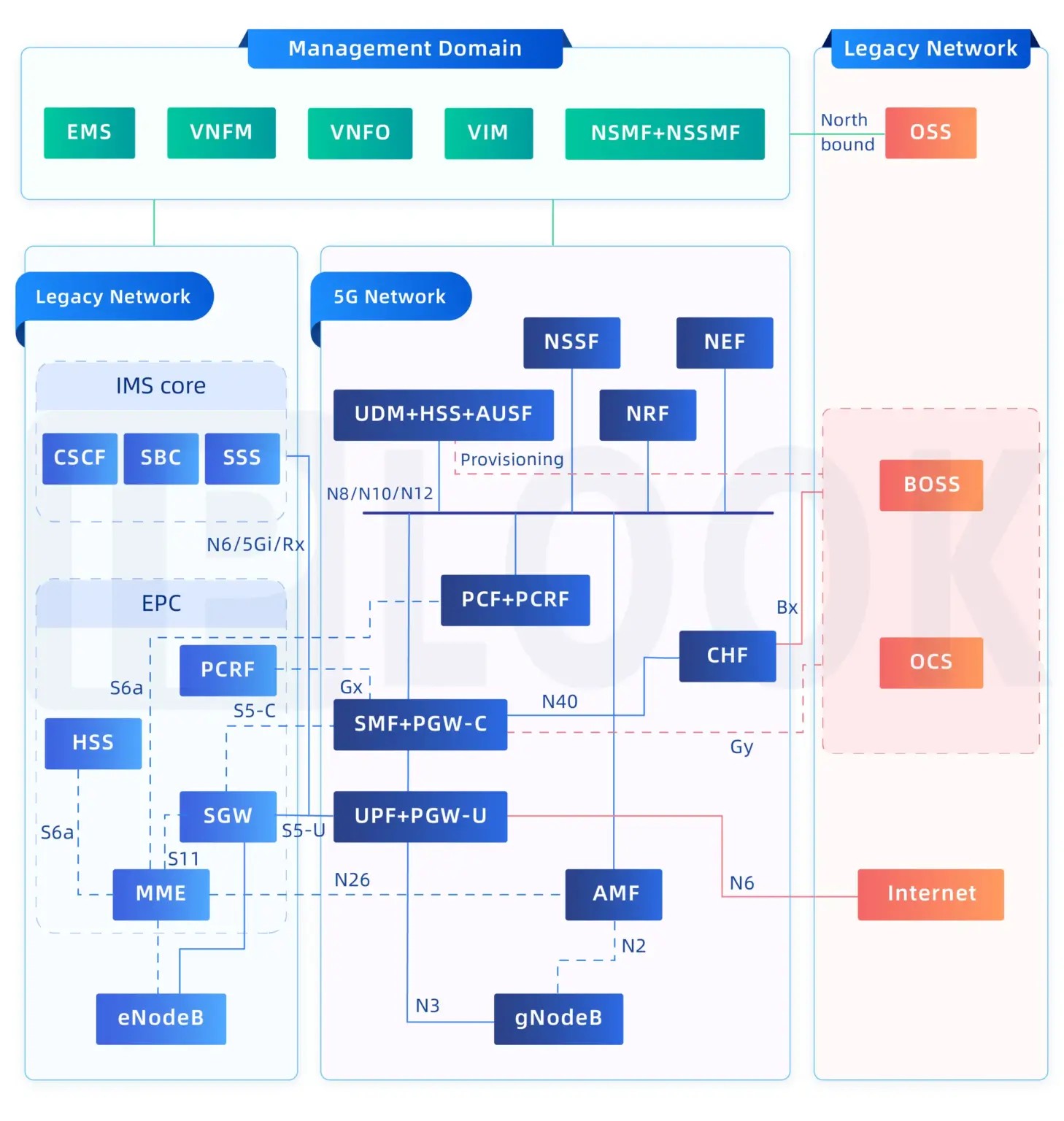
In the mobile core, two protocols quietly carry the weight of every text, call, and data session. The GPRS Tunneling Protocol (GTP) forms the backbone of user-data and signaling transport between the radio access and the packet gateway. It is the workhorse that tunnels our IP traffic through the operator’s infrastructure, yet it speaks a surprisingly simple language—create, modify, delete. GTP-C handles the signaling plane, setting up and tearing down tunnels as subscribers move, while GTP-U shuttles the actual bits. Unlike the rigid hierarchies of older telecom protocols, GTP operates with a certain efficiency born of necessity, having evolved alongside mobile broadband itself.
Then there’s Diameter, which lives up to its name as a superset of RADIUS. It is less a single protocol and more a framework for intricate conversations about policy, charging, and subscriber data. Every time your device latches onto the network or a real-time billing event fires, Diameter messages crisscross the core, navigating a mesh of specialized nodes—Policy and Charging Rules Function (PCRF), Home Subscriber Server (HSS), Online Charging System (OCS). It is a verbose, peer-to-peer protocol that replaced RADIUS’s primitive request-response model, now handling everything from QoS authorization to credit-control. Yet this flexibility comes at a cost: a sprawling web of AVPs (Attribute-Value Pairs) that can bewilder even seasoned engineers.
Together, GTP and Diameter form a signaling symphony that keeps mobile networks humming. GTP lays the tracks, dynamically rerouting traffic as users hail rides through the RAN; Diameter conducts the orchestration, ensuring each subscriber gets the right speed, the right access, and the right bill. Their interplay defines the modern LTE and early 5G architectures, though the shift to HTTP/2 and service-based interfaces in 5G core is already writing the next movement. For now, every ping, every stream, and every logged-in session is a note in this sprawling, hidden performance.
Designing for Scale: Deployment Models in 4G Core Networks
The move to IP-based architectures in 4G unlocked deployment models that could flex with subscriber growth. Rather than cramming everything into a single chassis, operators could distribute the Evolved Packet Core across data centers. The control plane—home to the MME and PCRF—often sat in regional hubs, while user plane gateways like the SGW and PGW were pushed closer to the network edge or aggregated into centralized packet gateways. This separation wasn't just about geography; it let engineers scale the signaling and data paths almost independently. When video traffic spiked, they could simply add more user plane capacity without touching the delicate session-state machinery.
Virtualization was still in its early innings when LTE went mainstream, yet many operators ran gateway functions on commercial off-the-shelf servers behind the scenes. The real art lay in how the PCRF—the policy brain—interacted with the PGW. A single PCRF instance might govern a dozen PGWs, but under heavy load, engineers learned to shard the policy realm by region or APN group. You'd see something similar in the MME pool concept: multiple MMEs sharing the load for a tracking area, with the S1-flex mechanism distributing connections. If one MME went down, others absorbed its UEs without dropping calls—a liveliness that monoliths could never offer.
What made these designs stick wasn't just technical elegance; it was the operational reality of rolling upgrades and failure domains. By carving the core into discrete functions, teams could upgrade an MME in the middle of the night while PGWs kept forwarding packets. They could also stage capacity regionally: deploy a new PGW in a high-growth metro area, route its own set of APNs through it, and leave the rest alone. This incremental scaling, paired with the separation of concerns between control and user planes, turned the 4G core into a template that the 5G service-based architecture would later inherit and refine.
Network Function Virtualization: Transforming the Core
The traditional telecommunication core has long relied on purpose-built hardware appliances, each meticulously designed for a specific function such as routing, firewalling, or session management. While robust, this approach has introduced rigidity, slowing down service innovation and inflating both capital and operational expenditures. Network Function Virtualization (NFV) upends this model by decoupling network functions from proprietary boxes, allowing them to run as software on standard servers. This shift is not merely technical—it redefines how networks are built, scaled, and monetized, turning what was once a hardware-centric monoculture into a flexible, software-driven ecosystem.
At the heart of NFV’s impact on the core is the ability to orchestrate virtualized functions dynamically, matching resources to demand in near real time. Instead of overprovisioning physical appliances to handle peak loads, operators can spin up instances of virtualized EPC or IMS components as traffic ebbs and flows. This elasticity not only improves efficiency but also dramatically shortens the launch cycle for new services. A mobile operator testing a novel edge computing service, for example, can deploy and tweak a virtualized user-plane function in days rather than months, all without disrupting the underlying physical infrastructure. The result is a core that breathes with the network, adapting to usage patterns and business needs alike.
Yet, NFV’s promise extends beyond cost and agility. It lays the groundwork for deeper automation and closed-loop operations, where the core can self-optimize based on real-time analytics. The virtualized environment also invites a richer ecosystem of software vendors, breaking the lock of the traditional few and fostering competition that drives innovation. However, this transformation is not without challenges—ensuring carrier-grade reliability, managing complex multi-vendor integrations, and navigating the cultural shift from hardware thinking to a DevOps mindset require sustained effort. The core is no longer a fixed monolith; it is becoming a programmable, intelligent fabric, and NFV is the catalyst that makes it possible.
Policy and Charging Control: Monetizing 4G Services
The evolution to 4G brought not just faster speeds but a fundamental shift in how operators could package and charge for connectivity. Policy and Charging Control (PCC) became the cornerstone of this transformation, allowing real-time, granular control over data usage so that every subscriber could receive a customized experience. Instead of flat-rate plans that left money on the table, carriers began crafting tiered speed tiers, zero-rated content partnerships, and time-based passes that turned network capacity into a flexible product line.
What made PCC truly powerful was its ability to embed charging logic into the session. A video stream could trigger a different billing rate than a messaging app, all enforced dynamically without manual intervention. This opened doors to creative bundling—think social media unlimited add-ons or premium HD video boosts—that customers willingly paid for, boosting average revenue per user without alienating the base with rigid data caps. The system’s real-time quota management also minimized bill shock, turning a former pain point into a trust builder.
From LTE to 5G: Core Network Evolution Strategies
Moving from LTE to 5G isn’t simply a radio upgrade; it demands a fundamental rethinking of the core network to support slicing, edge computing, and cloud-native agility. Operators are evaluating how to transition from the Evolved Packet Core (EPC) to the 5G Core (5GC) in a way that balances investment protection with the need for new capabilities. A common strategy involves deploying the 5GC alongside the existing EPC, initially using dual-mode core elements that can serve both 4G and 5G users. This phased approach allows operators to gradually introduce 5G standalone (SA) while continuing to support existing LTE traffic, avoiding a costly and risky rip-and-replace.
Containerization and service-based architecture (SBA) are at the heart of this evolution, enabling network functions to communicate via APIs in a more modular and scalable fashion. By decoupling control and user planes, operators can distribute user plane functions closer to the edge, slashing latency for applications like autonomous vehicles and industrial IoT. Yet this shift demands new operational practices, including CI/CD pipelines and automated testing, to manage the complexity of lifecycling dozens of microservices. Many operators are building proficiency in cloud-native environments on the EPC first, virtualizing key components before embracing a full 5GC SBA, thereby smoothing the learning curve.
Interworking between 4G and 5G cores is critical during the transition, and standards specify detailed procedures for handovers and session continuity. An operator might opt for a “capacity expansion” strategy, adding 5G radios to existing LTE grid and connecting them to the EPC via the Non-Standalone (NSA) architecture. Then, as the 5GC becomes mature and device ecosystem grows, they can migrate to the SA model, unlocking features like network slicing and ultra-reliable low-latency communication. Each path must be tailored to the operator’s spectrum holdings, service ambitions, and legacy infrastructure, but the end goal is a programmable core that can dynamically adapt to diverse use cases and traffic patterns.
FAQ
A 4G core, known as the Evolved Packet Core (EPC), is built entirely on IP, eliminating circuit-switched components found in 3G. Key differences include a flat architecture with fewer nodes, separation of control and user planes, and native support for both trusted and untrusted non-3GPP access. This design reduces latency and improves scalability compared to hierarchical 3G cores.
At the heart of the EPC, GTP (GPRS Tunneling Protocol) handles mobility and session management. Diameter replaces RADIUS for authentication, authorization, and accounting, offering better reliability. SCTP carries signaling traffic for robust transport, while PMIPv6 or GTP can be used for S2a/S2b interfaces toward non-3GPP networks. Each protocol is chosen for its efficiency in a high-speed, all-IP environment.
Greenfield deployments allow for a clean-slate EPC architecture, often leveraging virtualization and cloud-native elements, which accelerates time-to-market. Brownfield scenarios require careful interworking with 2G/3G cores, involving gateway upgrades, protocol translation, and staged migrations to avoid service disruption. Engineers often inherit existing site constraints and must balance modernization with backward compatibility.
Inter-RAT mobility and session continuity demand complex handover logic and context transfers. Diameter interworking with older RADIUS systems can cause signaling storms if not properly load-balanced. Mitigation involves deploying dedicated interworking functions, thorough pre-deployment testing, and capacity planning that accounts for signaling spikes during transition phases.
The EPC uses the MME for signaling and the Serving Gateway as a mobility anchor, enabling handovers without session drops. X2-based handovers allow direct eNodeB communication to minimize latency, while S1-based handovers handle inter-MME scenarios. The always-on IP connectivity model ensures that user sessions persist even when moving between cells or radio technologies.
The PCRF governs QoS and charging in real time, translating service-level agreements into technical policies. It communicates with gateways to enforce bandwidth limits, prioritize voice over data, or throttle peer-to-peer traffic. This dynamic control enables operators to offer tiered services and monetize network capabilities effectively.
Bearer-based QoS mechanisms assign different levels of service: default bearers for best-effort internet and dedicated bearers for premium services like VoLTE. Scheduling prioritization and resource allocation, guided by the PCRF, ensure low latency for real-time traffic while maintaining fairness for background applications.
Start with capacity modeling based on subscriber forecasts and traffic patterns. Choose between centralized or distributed core nodes depending on population density and geography. Then, design inter-site connectivity, select vendor equipment, and establish a clear migration path. Pilot testing in a controlled region validates performance before scaling to the entire network.
Conclusion
Delving into the professional 4G core network reveals an intricate blend of architectural elegance and protocol-driven efficiency, purpose-built to anchor mobile broadband. At its foundation lies the Evolved Packet Core, a flat, all-IP framework that dismantles legacy circuit-switched hierarchies. Here, the Mobility Management Entity stands as the control-plane sentinel, handling authentication, bearer setup, and idle-mode reachability, while the Serving Gateway and Packet Data Network Gateway jointly orchestrate user-plane traffic with surgical precision. This disaggregation isn't mere academic partitioning—it's the key to independent scaling and fault isolation. Driving this orchestration is a signaling symphony where GTP tunnels carve deterministic paths for packet flows, and Diameter-based interfaces broker policy, charging, and subscriber data exchanges across a web of dedicated functions. The interplay feels almost biological: GTP v1 handles the radio access edge, GTP v2 governs evolved packet core internals, and Diameter's attribute-value pairs carry the contextual intelligence that makes connectivity both personal and profitable.
Beyond the blueprints, deployment pragmatism rules. Designing for scale demands geographic redundancy, pooled MME architectures, and careful dimensioning of control-plane throughput to weather signaling storms. This is where Network Function Virtualization upends tradition, decoupling software logic from proprietary iron and inviting orchestrated agility via VNFs and NFV Infrastructure—a shift that slashes time-to-service and lays the bedrock for automation. Monetization hinges on the Policy and Charging Control framework, where dynamic rules, shaped by usage, location, or application, flow from the PCRF through the PCEF, turning raw bits into tiered revenue streams. Looking forward, the 4G core doesn't face obsolescence but evolution; it becomes a springboard for 5G, requiring operators to weave interworking solutions like N26 interface support, harness cloud-native refactoring, and adopt a dual-mode core that straddles both generations. This journey from monolithic to modular, from hardware-defined to software-empowered, encapsulates the professional core network not as a static entity but as a continuously adapting engine of connectivity.
Contact Us
Contact Person: Shimmy
Email: [email protected]
Tel/WhatsApp: 85253392231
Website: https://www.iplook.com