
Inside a Boiler Suit Factory: Crafting Durable Workwear with Precision
2026-11-16
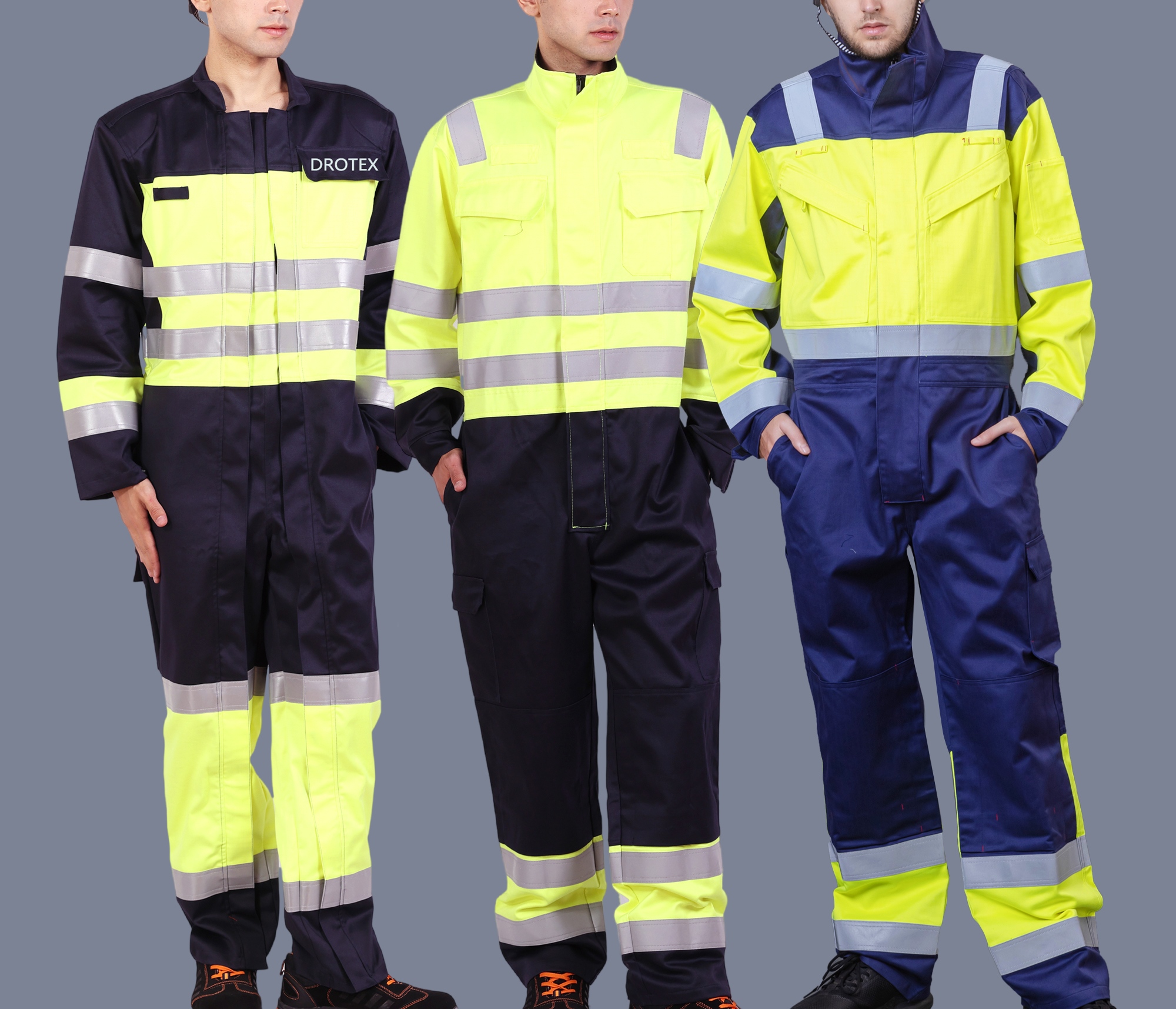
Every folded seam and reinforced stitch inside a boiler suit factory carries a weight that most buyers never see. At DROTEX, precision isn’t just a production standard—it’s a quiet obsession that shapes how heavy-duty workwear is born, from the first roll of flame-resistant fabric to the final press-stud inspection.
Raw Canvas to Reinforced Seams: The Fabric’s First Journey
Before a single stitch holds weight or weather, the story begins with an unassuming bolt of raw canvas. It arrives stiff, smelling of starch and possibility, its surface an even grid of tightly woven cotton. At this stage, the fabric is nothing more than potential—a blank slate that hasn’t yet learned to take the shape of a tent, a sail, or a heavy-duty cover. The first real step in its journey is a deliberate shock to the system: a deep, cold-water soak that relaxes the fibers and washes away the mill’s leftover sizing. This baptism softens the canvas just enough to make it workable, but it also tightens the weave permanently, setting the stage for the strength that needs to come later.
Once dried and re-stretched, the canvas faces the craftsman’s blade. Patterns are traced with no room for error—every panel cut to account for the way the fabric will pull, fold, and weather. This is where intuition meets geometry, because a straight line on the table doesn’t always translate to a stress-free seam under tension. The edges are then folded, doubled over, and sometimes even singed to prevent fraying. It’s a quiet, methodical rebellion against the weave’s natural urge to unravel. By the time the first needle punches through, the canvas has already been fundamentally transformed: it’s no longer just a cloth, but a series of potential stress points begging to be conquered.
The seam itself is where the fabric’s character evolves from passive material into active structure. Rather than a simple lockstitch that could tear through under strain, the canvas receives a flat-felled seam—where two layers interlock like a flattened puzzle, hiding the raw edge and doubling the fiber at the most vulnerable juncture. Heavy waxed thread is pulled through with a rigor that borders on violence, each puncture sealing the deal between pliability and resilience. By the time the reinforced seam is complete, the canvas has earned its scars. What was once a flat, anonymous plain is now shaped and stubborn, ready to take on wind, friction, and time without giving way at the points where it’s held together. That’s the fabric’s first journey, and everything that follows depends on these invisible, indestructible seams.
Pattern Whisperers: Why Precision Cutting Decides Longevity
In the world of garment making, the quiet hum of the cutting room often dictates how a piece lives through years of wear. It isn't just about following a stencil; it's reading the fabric's breath, the subtle grain that can twist a seam over time. A blade guided by intuition rather than rigid marks allows the material to settle into its natural drape. This whisper-level dialogue between cutter and cloth ensures that a jacket shoulder never pulls, and a hem never sags prematurely—things that no amount of stitching can correct after the cut is made.
Precision here is tactile knowledge passed down through hands, not just digital files. It's knowing that a silk charmeuse demands a gentler angle than a stiff denim, or that a plaid check requires a moment of pause to match the pocket flaps exactly. These decisions happen in seconds but echo for decades. When a cutter respects the fabric's own memory, the finished garment resists distortion through countless dry cleanings and wears. It's the kind of longevity that doesn't come from a tag but from those quiet, decisive moments at the table.
What separates a fleeting fashion piece from a wardrobe faithful is this foundational moment of truth. A millimeter misjudged at the armhole can cascade into daily discomfort; a perfectly aligned chevron seam becomes a signature of integrity. The whisperers in this craft never advertise their skill, yet their work speaks every time a collar lies flat without curling. Their precision is the invisible backbone of garments that outlive trends, quietly proving that the first cut holds the entire life of a piece within its edge.
Needle Against Abrasion: The Stitch Patterns That Refuse to Fray
Fabric breaks down where it moves the most. Shoulder seams, pocket edges, the inner thigh of work pants — these spots collect friction like a debt. The difference between a garment that disintegrates in six months and one that outlasts its owner often comes down to how the thread travels through the cloth. A straight stitch alone is a line of perforations waiting to tear; it has no give. But when a needle starts walking in zigzags, loops, or interlocking chains, it stops just holding pieces together and starts distributing stress across a wider territory.
Take the humble bar tack. It looks almost like a dense little embroidery, a concentrated cluster of tight zigzag stitches thrown back and forth until a ridge of thread armor forms. You see it at the top of belt loops and the corners of pockets, right where a simple seam would peel open under tension. The thread almost buries itself, creating a reinforced island that refuses to split. Elsewhere, the flat-felled seam hides its raw edge by folding fabric into fabric, then stitching through all those layers with a row of parallel lines. Denim lives through this construction; every time you sit down, the seam rubs against itself instead of unspooling into fringe.
Stretch fabrics demanded a different kind of thinking. A lockstitch snaps when pulled, so coverstitch machines arrived with multiple needles dancing above a looper below, laying down rows of chain stitches that can extend like tiny accordions. This is the secret inside a yoga waistband that never pops its threads. Even the overlooked welt seam plays a role — stitching from the back while a single line shows on the front, burying the bulk on the inside where abrasion can't gnaw at it. Each pattern is a quiet calculation, a negotiation between needle and material that says: you can bend, you can rub, you can strain, but you will not come apart here.”
Hardware That Holds: Zippers, Snaps, and the Test of a Thousand Pulls
Before you trust a garment to stay closed during a busy day, spare a thought for the tiny mechanisms that keep everything in place. A zipper isn’t just a strip of teeth—it’s a precisely engineered track where one misaligned coil can turn a smooth glide into a stubborn snag. Snaps, on the other hand, rely on that satisfying ‘click’ that tells you two halves have locked into a secure embrace, yet their hidden spring can weaken long before the fabric around them shows any wear. These aren’t just fasteners; they’re the unsung guardians of pockets, fly fronts, and that one jacket you reach for every autumn.
The true test isn’t the first gentle tug in a fitting room—it’s the thousandth absent-minded pull when you’re rushing out the door. Quality zippers use materials like molded nylon or polished metal that distribute stress across multiple teeth, while cheaper versions let a single point bear the brunt until it eventually gives way. Snaps face a quieter trial: each fastening compresses the internal ring just a fraction more, until one day it holds only by habit rather than engineering. The best ones are those that still bite decisively after countless cycles, their tension barely diminished.
There’s a quiet confidence that comes from hardware you never have to think about. When a zipper’s pull tab dips naturally to the lock position or a snap aligns without fumbling, the entire piece feels more intentional. These components bridge the gap between raw material and something truly wearable, and they deserve the same consideration as the fabric they bind. Over time, the ones that last aren’t the showiest—they’re the ones that simply don’t announce their failure.
The Finishing Gauntlet: Heat, Pressure, and the Final Crease
There’s a moment in the workshop when the air thickens with focus—this is the gauntlet, where a flawless edge or a crisp fold separates the amateur from the artisan. Heat arrives like a whispered warning, not a blunt force. You coax it through brass tools and polished plates, letting it seep into the material’s memory just enough to relax the fibers without scorching their soul. One degree too eager and the surface blushes with burn, one heartbeat too slow and the impression remains a faint, forgotten sigh. Every move here is a negotiation with impermanence.
Pressure is the silent partner that turns intention into permanence. It’s not about muscle—it’s about knowing exactly where the material will yield and where it will resist. The press descends like a held breath, even and deliberate, marrying heat to structure until a line appears that wasn’t there before, sharp as a horizon. Skilled hands read the subtle give beneath the leather or paper, adjusting in micro-increments that a machine would flatten into indifference. This is where mistakes live: a tremor in the wrist, a misjudged clamp, an uneven bolster that turns a potential masterpiece into a lesson you won’t forget.
Then comes the final crease—not a fold, but a declaration. It’s the spine’s new architecture, the wallet’s obedient hinge, the book cover that now knows how to open and close with quiet authority. As the tool lifts, the ghost of warmth trails behind, and what was once a flat blank stares back with purpose. The crease doesn’t just shape the piece; it seals the maker’s dialogue with the material. After the gauntlet, there’s no more second-guessing. The object breathes on its own, carrying the weight of heat and pressure as a story worn on its skin.
Beyond the Assembly Line: Hands That Inspect Every Pocket and Pleat
Machines can stitch at lightning speed, but they will never notice the slight pull in a seam where the thread tension wavered for a split second. In our workshop, the real work begins where the conveyor belt ends. Each garment is turned inside out, held up to natural light, and run through fingers that have spent years learning the language of fabric. A pocket isn't just checked for size—it’s tested with the weight of a phone, a set of keys, the absent-minded shove of a hand in a hurry. If it doesn’t feel like a second skin, it goes back.
Pleats are where speed truly loses its grip. A machine can press twenty identical folds in under a minute, but only a human eye catches the one that falls half a millimeter off pattern, throwing the drape into disharmony. Our inspectors don’t just measure—they lift the skirt, let it hang, watch how the pleats recover after being crushed in a fist. They know that a well-made pleat should hold memory without stiffness, structure without surrender. That kind of judgment can’t be programmed into a sensor.
This isn’t about rejecting technology; it’s about remembering what clothes actually endure. Before a jacket leaves, every button is twisted, every lining seam is tugged from the inside, and every pocket bag is pulled outward to check for the tiny gaps that later become gaping holes. It’s slow, imperfectly human work that catches what automated systems miss: the stiff edge of a label that will itch a neck, the hidden knot in a drawstring, the quiet dignity of a garment made to last beyond the season.
FAQ
Durability starts with fabric choice. We use heavyweight, tightly woven cotton or cotton-poly blends that resist tearing, then reinforce all stress points—knees, elbows, and pocket corners—with bartack stitching and double-layered panels. Each seam is lock-stitched with high-tensile thread so nothing unravels under strain.
We rely on automated cutting tables guided by digital patterns, but the real precision comes from the hands that align the fabric grain beforehand. Even a slight skew in the weave can throw off how the suit hangs after a hundred washes, so we check and recheck the lay before the blade ever touches the cloth.
Machines can assemble quickly, but only a skilled sewer can ease a sleeve cap into an armhole without puckering, or taper a pocket edge so it sits flat against the body. Our final inspectors also run their fingers along every inch of the interior seams—that tactile check catches rough spots that machines miss.
That stiffness comes from the sizing agent applied to the yarn to withstand high-speed weaving and sewing. After a few wears and washes, it breaks down and the fabric softens. We pre-shrink and lightly enzyme-wash select styles to give a broken-in feel from day one without compromising the fabric’s strength.
It’s a trade-off. We blend breathable fibers like cotton with synthetic reinforcing only where it’s needed—not the whole garment. Ventilation details help too: underarm eyelets, mesh-lined back yokes, and zippered chest vents that can be opened on hot days while the heavy outer shell stays intact.
First, a tensile test on random fabric swatches. Then each suit goes onto a full-body form where we check fit alignment, zipper function, and pocket placement with a ruler. Spot checks include a wash-and-dry cycle to measure shrinkage and color fastness. If a snap deviates by more than a millimeter, the lot is reworked.
Conclusion
Walking into a boiler suit factory, you quickly realize that durability is not just a buzzword but a deliberate, tactile process. It starts with raw canvas that’s inspected and fed through massive spreading tables, where even the smallest weave flaw is marked for rejection. Then the patterns are laid down with surgical precision by cutters who know that a millimeter’s drift in the grain line can doom a pair of coveralls to rip early at the crotch or shoulder. Watching the steel rule press down and the round knife glide, you get a sense that this is less about fashion and more about architecture. The panels are then bundled and shuttled to a battalion of industrial machines, each set up with specific needle sizes and thread tensions to tackle the heavy fabric without skipping a stitch.
The assembly line hums with a choreography of reinforcement: double-felled seams running down outer legs, bar tacks punching dense knot-like anchors at pocket corners, and chain-stitched side seams built to flex without popping. Hardware stations compress heavy-duty zippers and solid brass snaps that can withstand thousands of cycles—tested not just for pull strength but for how they’ll behave after a year of grease, dust, and scrubbing. Once the garment takes shape, it enters what workers call the finishing gauntlet, where heat presses lock in pleats and seal collar points until the boiler suit looks crisp and unforgiving. But the final step isn’t a machine at all; it’s a pair of hands, slowly tracing every pocket, checking every pleat, and flipping the suit inside out to hunt for hanging threads. That human checkpoint is what delivers a garment that feels less like a product and more like a promise made in twill and rivets.
Contact Us
Contact Person: Sandy
Email: [email protected]
Tel/WhatsApp: 86150 8310 5120
Website: https://www.frdrotex.com