

High Quality Travertine Flexible Stone Transforms Walls with Natural Texture and Warmth
2026-08-19
Think of a wall that carries the sun-baked character of Italian travertine, yet bends and wraps like a flexible veneer—this is the quiet revolution Magic Stone brings to interiors. High-quality travertine flexible stone doesn't just cover a surface; it layers rooms with natural texture and a warmth that painted drywall can only imitate. In this post, we'll look at how that organic, stone-on-touch feel is achieved without the weight or cost of traditional slabs, and why more designers are turning to it for feature walls that feel genuinely alive.
Travertine's Uneven Surface Is Exactly Why It Feels Expensive
There's a quiet luxury in imperfection, and travertine leans into that better than almost any other stone. Run your hand across its surface and you'll notice the subtle pits, the soft ridges, the way light catches on each low valley instead of bouncing off a mirror-smooth finish. That unevenness isn't a flaw left over from the quarry—it's the material telling you it was formed drop by drop over thousands of years, not pressed and polished into sameness by a factory line.
What this texture does to a room is hard to replicate with cheaper imitations. A perfectly flat porcelain tile might read as efficient, even clinical, but travertine's gentle irregularity draws the eye to wander, to pause, to touch. It gives a countertop or floor a sense of having settled in, like the space has been lived in and earned its character. That kind of visual and tactile depth feels expensive because it can't be rushed—it has to be sourced, cut, and installed with care for the stone's natural topography.
Designers often talk about wanting materials that 'warm up' a space, and travertine's uneven surface is doing a lot of that work up front. The hollows hold shadows in a way that softens edges, and the raised areas catch a slight sheen underfoot. It's not a perfect, glossy reflection, but rather a quiet interplay of light and texture that suggests age, weight, and a restrained kind of wealth—one that doesn't need to shout to be noticed.
The Flexible Stone That Lets You Keep Your Original Walls
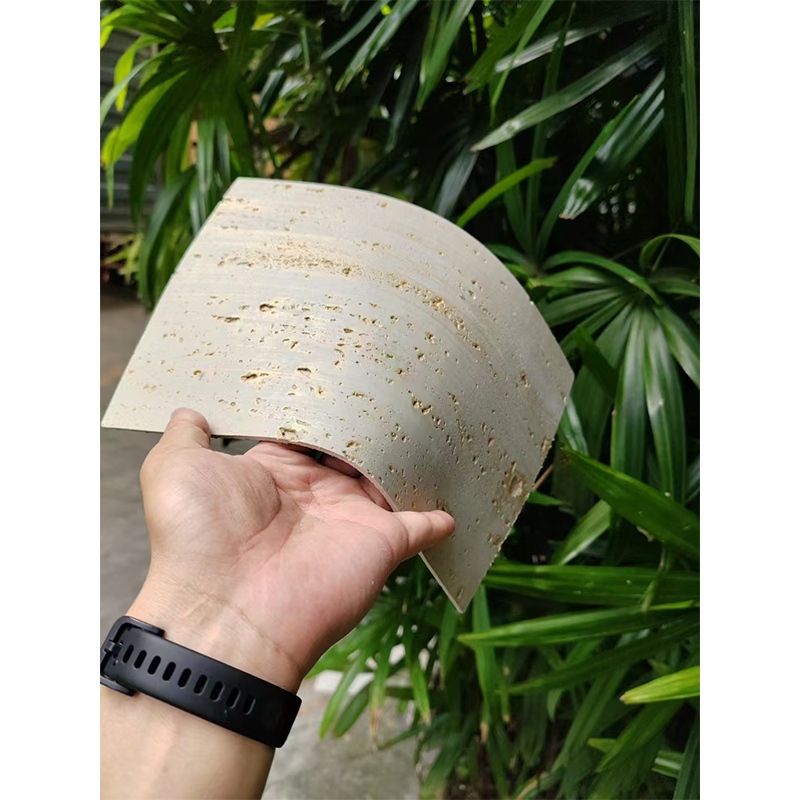
Ripping out old plaster or tile usually comes first in a wall makeover, but flexible stone skips that mess. Its cloth-like backing bends across existing brick, concrete, or drywall, leaving the original surface in place and adding a natural stone layer only a few millimeters thick.
Because each sheet weighs far less than quarried stone, you can lift and position it without hiring a crew. Standard scissors or a knife handle the cuts, and the backing hides hairline cracks, old paint drips, and uneven patches instead of forcing you to repair them first.
That makes it a practical choice for fireplace surrounds, bathroom feature walls, kitchen backsplashes, or rented apartments where demolition isn't allowed. The original wall stays untouched underneath, so the update feels substantial without becoming permanent.
Where Warm Light Hits Natural Stone, Rooms Change Their Mood
Natural stone has a way of sitting quietly in a room until the light finds it. In the early morning, a low sun slides across a limestone wall and suddenly the surface isn't just beige or grey—it holds a faint blush, a grain you never noticed at noon. That shift is enough to soften the whole room, turning a hard material into something almost breathing.
Later in the day, warmer light from a west-facing window can make travertine glow like honey, pulling out ochre streaks that were invisible under cool daylight. Corners stop feeling sharp; the room seems to lean in, closer and calmer. It's not a change you can point to easily, but you feel it the moment you cross the threshold.
Even after sunset, a single warm lamp placed near a slate floor or a marble counter can rebuild that mood from scratch. The stone absorbs the glow and gives it back slowly, so the light doesn't just sit on the surface—it seems to come from inside. That's when a room stops being a collection of finishes and starts behaving like a place with its own temperament.
A Stone Finish That Bends Around Corners and Curves
Most stone finishes crack or lift the moment they meet a tight radius. This one behaves differently. The aggregate is suspended in a flexible resin that allows it to follow curved walls, rounded columns, and rounded countertop edges without losing the texture. Trowel it around a 90-degree corner and the stone pattern continues as if the surface was cast in one piece.
The bend isn't just about flexibility—it's about visual continuity. On curved bar fronts or arched niches, standard panels force you to piece together small sections and disguise the joints. Here the material moves with the substrate, so the grain direction and color density stay consistent from flat to curve. You get a continuous stone look with no visible seams or patchwork.
The Quiet Luxury of a Wall That Isn't Perfectly Smooth
There is a particular kind of calm that settles over a room when the walls do not try too hard. The faint undulation of hand-troweled plaster, the ghost of a brushstroke in limewash, the tiny shadow cast by a slight ridge in clay—these are not flaws to be corrected but textures that hold light differently throughout the day. A perfectly smooth wall reflects light uniformly, and in that uniformity there is a subtle demand for attention. An imperfect wall, by contrast, lets the eye rest. It doesn't shout for admiration; it simply exists, like a well-worn linen shirt or a stone step smoothed by decades of footsteps.
Luxury, in this sense, is not about absence of defect but about presence of touch. A wall finished by hand carries the memory of the hand that made it—the slight pressure of a trowel, the pause between passes, the uneven absorption of pigment. These traces cannot be replicated by a machine, and that is precisely the point. In a world increasingly dominated by flawless digital surfaces and mass-produced uniformity, a wall that is not perfectly smooth offers something rarer: evidence of time, of process, of a human decision to let go of control. It whispers rather than announces, and that restraint feels more indulgent than any mirror-like gloss.
The quiet luxury of such a wall also lies in how it changes. As daylight moves across the room, the uneven surface catches and releases light in shifting patterns. A shadow deepens in one corner, a highlight appears along a gentle swell. The wall becomes a slow, silent performance that never repeats exactly. It is not static decoration but a living backdrop that invites you to notice the hour, the weather, the angle of the sun. That attentiveness—to the subtle, the imperfect, the alive—is the true privilege. It asks nothing of you except to be present, and in return it offers a kind of comfort that no pristine, machine-flat surface ever could.
Why First-Time Renovators Choose This Over Ceramic Tile
First-time renovators rarely know what they're signing up for until the first box of materials arrives. Ceramic tile looks great in a showroom, but once you factor in cutting, leveling, grout lines, and the inevitable cracked edge from a slightly uneven subfloor, the charm wears off fast. That's why so many people end up gravitating toward a simpler alternative that doesn't demand a wet saw or a week of dusty labor.
The real appeal isn't just easier installation—it's predictability. When you're already juggling contractor schedules, paint colors, and a budget that keeps shifting, the last thing you need is a flooring material that punishes every small mistake. A more forgiving option lets you finish the job on a weekend, walk on it the next day, and still have enough left in the wallet to buy that light fixture you've been eyeing.
And here's the part nobody tells you upfront: ceramic tile feels cold underfoot in the morning, echoes when the kids run through the hallway, and starts showing hairline cracks the first time a heavy pot hits it. First-timers who've lived with tile before understand the trade-off. Those who choose the alternative aren't settling—they're just skipping the learning curve and going straight to a floor that actually fits how they live.
FAQ
Most panels run around 2 to 4 millimeters thick, which keeps them surprisingly light—usually under 3 kilograms per square meter. That thin profile is what lets them bend and wrap around surfaces without cracking.
If you can handle a utility knife and a notched trowel, you can probably do it yourself. The panels cut with a sharp blade, and you just apply a polymer-modified adhesive to the wall and press them on. Just make sure the wall is clean and primed first.
The surface is made from real stone particles bonded to a flexible backing, so you get authentic pits and veining that catch light differently across the wall. Up close it has a slightly matte, mineral feel rather than a glossy vinyl look.
Yes, but seal the surface after installation to protect against moisture and stains. The backing itself is waterproof, but the stone layer is porous, so a good penetrating sealer will keep water from soaking in and causing discoloration.
Stick to a soft microfiber cloth and warm water with a few drops of pH-neutral soap. Avoid abrasive scrubbers and acidic cleaners like vinegar or citrus sprays, which can eat into the stone surface over time.
That's one of their strong points. The flexible backing lets you bend the material around gentle curves, columns, or arched openings. For tight radii, you may need to warm the panel slightly with a heat gun so it relaxes and conforms without kinking.
It shines in spaces that need a warm, organic focal point—think living room accent walls, entryways, or fireplace surrounds. It pairs well with wood, matte black metal, and neutral furnishings, and it works in everything from Mediterranean to modern organic interiors.
It's typically less expensive per square meter than solid travertine tile, and because you don't need cement board or a tile saw, the install goes much faster. You lose some of the deep three-dimensional character of thick stone, but you gain flexibility and a much simpler DIY path.
Conclusion
There’s a reason travertine has never really gone out of style. The subtle pits, ridges, and tonal shifts across its surface read as intentional rather than imperfect. High-quality travertine flexible stone leans into that character instead of masking it. Because the material is thin and pliable, it can follow a curved wall, wrap a column, or turn a sharp corner without the heavy seams or awkward cuts you’d get with ceramic tile. That means the warm, organic texture carries through the room uninterrupted, and the wall doesn’t shout for attention so much as settle into a low, confident presence. As daylight moves across the surface, shadows gather in the shallow recesses and then release, shifting the mood from bright and airy in the morning to soft and grounded by evening.
For anyone renovating for the first time, the appeal goes beyond appearance. You don’t need to strip away your existing drywall or plaster to get the look of solid stone. The flexible sheet adheres directly over what’s already there, saving time, mess, and the cost of demolition. That practical advantage often becomes the deciding factor against ceramic tile, which demands a flat, stable substrate and leaves grout lines to maintain. With travertine flexible stone, the result is a continuous natural surface that feels deliberate, warm, and quietly luxurious without being perfectly smooth. It’s that very lack of uniformity that makes a room feel expensive, as if the wall was always meant to be that way.
Contact Us
Contact Person: Vito
Email: [email protected]
Tel/WhatsApp: 86 13088879266
Website: https://www.magicstonemcm.com