
Custom Football Socks That Let Your Team Stand Out on the Field
2026-09-05
Game day is about more than just skill—it's about identity. When your squad steps onto the pitch, every detail counts, right down to the socks. Custom football socks from Mingjun don't just complete the uniform; they turn it into a statement. Whether you're chasing a league title or simply want your five-a-side crew to look the part, the right pair can boost morale and make you impossible to miss. Here's how to design socks that let your team truly stand out.
Own Every Match With a Look That's All Yours
What fans remember long after the final whistle isn't always the score—it's the way you carried yourself, the small details that whispered (or shouted) who you are. Every match is a blank canvas, and your look is the signature scrawled across it. From the way you lace your boots to the wristband color that catches the light during warm-ups, these choices send a signal no one else can copy. When you step onto the field, the first thing an opponent notices shouldn't just be your footwork—it should be the quiet confidence of a look that says, "This is me, right now."
Dressing in something that feels unmistakably yours does more than turn heads—it shifts your internal dial. That fitted sleeve, the pattern only you would pick, the tiny emblem stitched near the hem: these aren't decorations. They're anchors. When the match tightens and the noise rises, a glance at your own gear reminds you to play your game, not someone else's. That kind of clarity makes your decisions faster and your presence louder. Soon, people don't just watch the match; they watch for you.
Start building that recognition in training, not on game day. Experiment with what makes you feel most like yourself—an old headband, a pair of shoes you've marked with your own colors, even the way you fold your socks. Keep what works, drop what doesn't, until walking out feels less like a routine and more like a statement. By the time the real moments arrive, your look will already be part of your muscle memory. Win or lose, you'll own something that no one can take away: a look that's all yours.
From Your Sketch to the Starting Lineup
Every jersey, warm-up top, or pair of shorts begins as a rough pencil line on a napkin or a quick layer in a design app. That first sketch rarely looks like much—maybe a scribbled collar, a color block that doesn't sit right, a number font that seemed better in your head. But it's the moment the idea stops being a vague 'what if' and becomes something you can point to, erase, and redraw.
The jump from that sketch to the actual starting lineup is where most concepts stall. You need a pattern that fits real athletes, not just a flat drawing. Fabrics stretch, shoulder seams pull, and colors shift under arena lights. A good design survives contact: the fit has to work when a point guard cuts hard left, and the number placement can't disappear when a forward hunches on defense. That means pattern revisions, sample fittings, and sometimes scrapping a whole sleeve design because it looks great on paper but binds at the armpit.
What makes it to the court isn't the prettiest sketch—it's the one that solves those small, boring problems. The final lineup gear is a quiet translation of that first idea, edited by sweat, tape measures, and a few late-night printer proofs. So keep the sketch messy, but keep everything after it precise.
Built to Survive a Full 90 Minutes
The final ten minutes separate finishers from everyone else. Legs burn, touch gets heavy, and the pitch suddenly feels wider. Most players start strong but fade when the game turns scrappy. This boot is built for that exact stretch—no mid-game softening, no heel slip, no wasted energy re-adjusting your feet.
A dual-density midsole absorbs repeated impact without flattening, while the reinforced toe box holds its shape through late tackles and dragged shots. The upper breathes enough to keep socks from turning into wet rags, yet stays structured around the midfoot so lateral cuts stay sharp at 88 minutes.
The real difference is confidence. When you're not thinking about blisters, hot spots, or stud pressure, you can focus on the run that breaks the line. That's what surviving 90 minutes actually means—being dangerous when everyone else is just holding on.
Bold Patterns and Colors That Don't Quit
Bold patterns demand attention the moment they enter a room. Think oversized florals, sharp geometrics, or stripes in unexpected color pairings — these aren't timid choices. They throw a punch of energy that refuses to fade into the background. A vivid cobalt against a fiery orange, or a chunky checkerboard in black and emerald, creates a visual rhythm that keeps the eye moving long after the first glance.
What makes these combos so enduring is their refusal to play it safe. While muted palettes tire quickly, a well-chosen clash of hues and shapes holds its ground. A wall covered in a large-scale tropical print or a sofa upholstered in a jagged abstract pattern doesn't just decorate a space — it defines it. And because the contrast is so deliberate, the look never reads as dated; it simply feels alive.
For anyone tired of beige-on-beige boredom, this approach is a wake-up call. It's about committing to a point of view and letting it speak loudly. Whether it's through a single accent wall, a throw pillow, or an entire wardrobe, bold patterns and colors don't quit because they're built on confidence, not trends. They stay sharp, loud, and utterly unapologetic.
A Fit That Moves the Way Your Team Does
Most uniforms treat a torso like a static block. Ours starts from the opposite assumption: people reach, twist, squat, and stretch in ways no spec sheet ever captured. The shoulder seams are set back just enough that lifting a box or pulling a roll of cable doesn't yank the collar sideways. The side panels use a knit that gives along the ribs instead of fighting them, so a deep bend to check a low shelf feels less like a tug-of-war with your own shirt.
The difference becomes obvious the first time someone crouches to grab a tool from a bottom drawer. There's no ride-up at the waist, no bunching behind the knees. The fabric has a subtle two-way stretch that follows the body's natural lines rather than snapping back like a rubber band. And because real work rarely happens in a single, clean motion, the fit stays quiet through the awkward transitions too—the half-twist to pass something behind you, the off-balance lean over the edge of a desk, the sudden sprint when a schedule slips.
We fit across a range of body types, not just the average mannequin. That means a longer back panel for people who actually reach overhead, a slightly tapered leg that doesn't pool over boots, and sleeve lengths that don't leave wrists exposed mid-task. The result is a uniform that feels less like a company requirement and more like the best-fitting thing in your closet—except it's built to survive whatever the team throws at it this week.
Small Details, Big Team Impact
A teammate who remembers that you hate morning meetings and shifts the sync to after lunch isn’t doing anything heroic. But that small adjustment tells you someone is paying attention. Over time, these micro-considerations build a map of mutual respect that makes the team feel less like a group of people completing tasks and more like a group of people who want to work together.
Tiny reforms in how we share work often carry more weight than grand strategy offsites. Adding a one-line summary at the top of a long thread, tagging the right person in a document instead of broadcasting to everyone, or leaving a clear note about why a decision changed saves hours of quiet confusion. These habits don’t appear in performance reviews, but they quietly lower the friction that drains energy from a team.
The real power of small details is that they compound. A team that consistently handles the small things well starts to trust each other on the big things. That trust shows up when someone admits a mistake early, asks for help without hesitation, or challenges an idea directly because they know the relationship can take it. None of that begins with a bold mission statement. It begins with someone noticing that a teammate was overloaded and offering to take the smallest task off their plate.
FAQ
They give your squad a unified look that off-the-shelf options just can't match. You control the colors, the patterns, and even small details like stripes or initials, so the socks become part of your identity instead of an afterthought.
You can start with a blank sock and build it up from there. Pick a base color, add contrasting heels or toes, choose band widths, and place your team name or number where it feels right. There's no fixed menu, so most teams end up with something nobody else has.
A blend with nylon and spandex tends to work well because it stretches without losing shape. Look for reinforced heels and toes, and a cushioned footbed if your players are on turf a lot. Cotton blends feel soft but usually wear out faster under real game conditions.
Yes, most custom sock makers can work from a photo or a color code. Send over your jersey design and they'll adjust the thread colors to sit right next to your kit. Logos are usually knit or embroidered depending on the detail level you want.
You typically confirm the design, send in the sizes for each player, and get a digital mock-up before anything goes into production. From there the socks are made in one batch, so every pair matches, and they ship together to one address.
Yes, but it's more about cohesion than performance. When everyone walks out with matching socks, the team looks tighter and more prepared. Players also tend to take more pride in gear that feels specific to them.
Most manufacturers offer a range that spans youth small through adult extra large. Some also offer a women's cut for a narrower foot. It's best to check the size chart against shoe size rather than assume a medium will fit everyone.
Many suppliers set a minimum around 10 to 12 pairs, but it varies. If you only need a handful for a small-sided team, some shops will accept smaller runs for a slightly higher per-pair price.
Conclusion
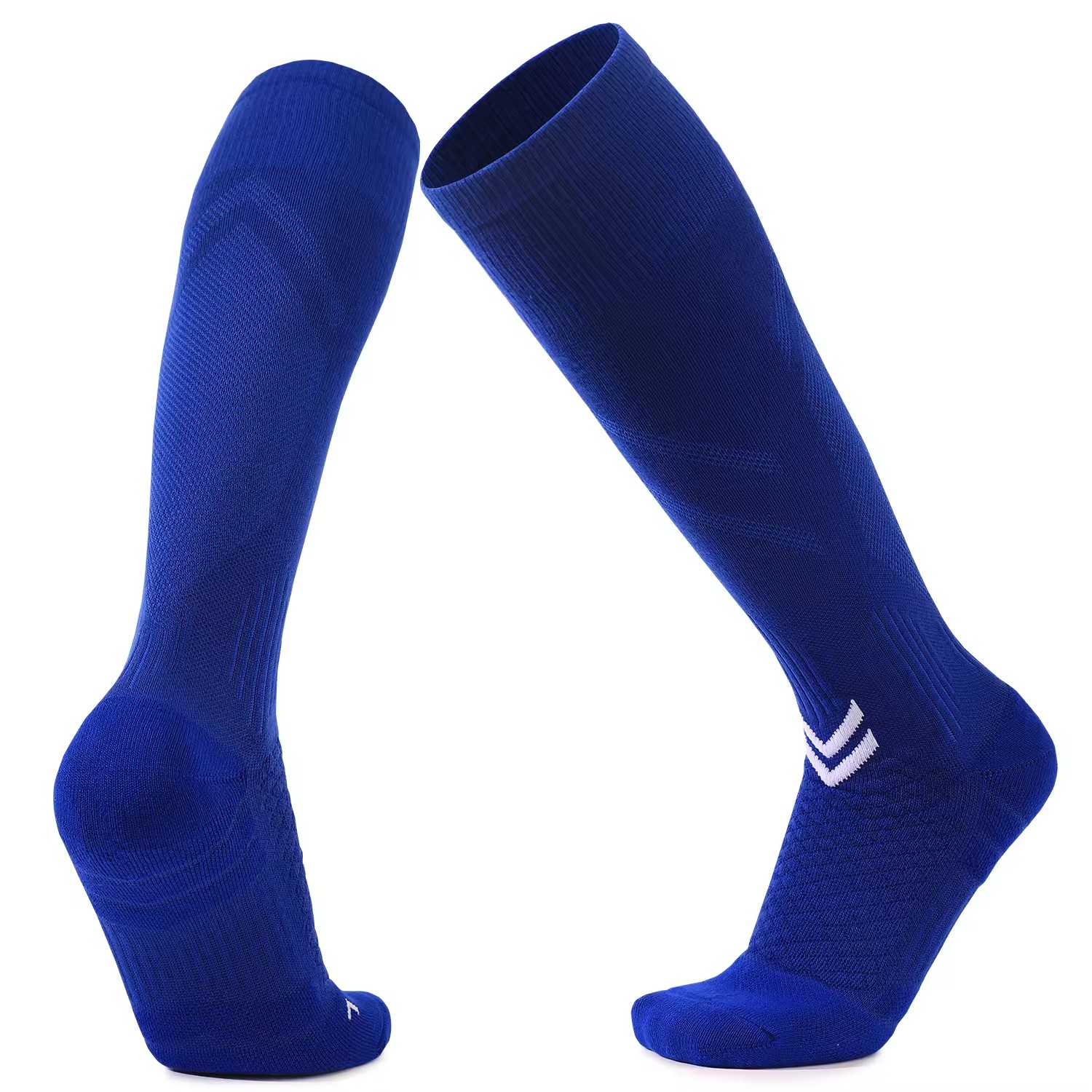
When your squad steps onto the pitch, the last thing you want is to blend into the crowd. These custom football socks are made to give your team a look that's entirely its own. You start with a sketch—a rough idea, a logo, a color burst—and that spark becomes part of the actual lineup. No cookie-cutter templates, no borrowing someone else's style. The bold patterns and colors don't fade into the background after a few washes, either. They stay loud and proud, match after match, so your team's identity is unmistakable from the first whistle. This isn't just gear; it's a statement that you own every minute of the game.
Of course, looks mean nothing if the socks can't handle a full 90 minutes. That's why these are built with reinforced heels and toes, breathable zones, and yarns that hold their shape through sliding tackles and sudden sprints. The fit follows the natural movement of your foot and calf, so nothing bunches, slips, or digs in when you're chasing a through ball. Even the little things get attention—a subtle stripe that echoes your club's crest, a contrast toe seam, a knit-in player number. Those small details don't just look sharp; they pull the whole kit together and make every player feel like part of something bigger. When the final whistle blows, your socks should still look as determined as your team.
Contact Us
Contact Person: Tiga
Email: [email protected]
Tel/WhatsApp: 8613058331729
Website: https://www.china-socksfactory.com/