

China High Class Cleanroom: Essential Features and Industry Applications
2026-09-03
Walk into a high-class cleanroom in China and the first thing that hits you isn't the gleaming stainless steel—it's the obsessive control. Every particle, every pressure differential, every footstep is accounted for. That precision is no accident. It's the result of engineering choices that few outsiders ever see. In this article, we pull back the curtain on the essential features that separate a truly high-class Chinese cleanroom from a merely compliant one—and where those features matter most, from biopharma to semiconductors. As a team that has designed and built these environments at GENO Pharmatech, we know where the hidden failure points are and what buyers should demand.
Cleanroom Classification Is Only the Starting Point
Cleanroom classification, typically performed according to ISO 14644-1, provides a baseline snapshot of particle concentrations under controlled conditions. Yet a certificate showing a class ISO 7 or ISO 5 environment does not automatically mean the room will remain that way during routine operations. The classification test is a starting point—a confirmation that the cleanroom can meet defined cleanliness levels when properly prepared and tested. Real-world performance depends on what happens after the certificate is issued.
The gap between classification and operational reality often widens when people, materials, and equipment enter the space. Gowning procedures, material transfer protocols, and cleaning practices all introduce particles and disrupt airflow patterns. Without consistent training and disciplined behavior, even a well-classified cleanroom can quickly lose control. Monitoring programs must therefore move beyond periodic particle counts to include continuous data on pressure differentials, temperature, humidity, and airborne viable counts. These ongoing measurements reveal how the room behaves during active manufacturing, not just under test conditions.
Treating classification as the finish line leads to complacency. A more effective approach is to view it as the first step in a cycle of assessment, control, and verification. Risk assessments identify critical locations where contamination would have the greatest impact, and sampling plans focus on those areas. Trends in environmental data, not a single pass/fail result, provide early warning of drifts. Only by integrating classification with routine monitoring and a culture of contamination control can a facility ensure that its cleanroom performs as intended over time.
Laminar Flow and Pressure Cascades in Chinese High-Tech Plants
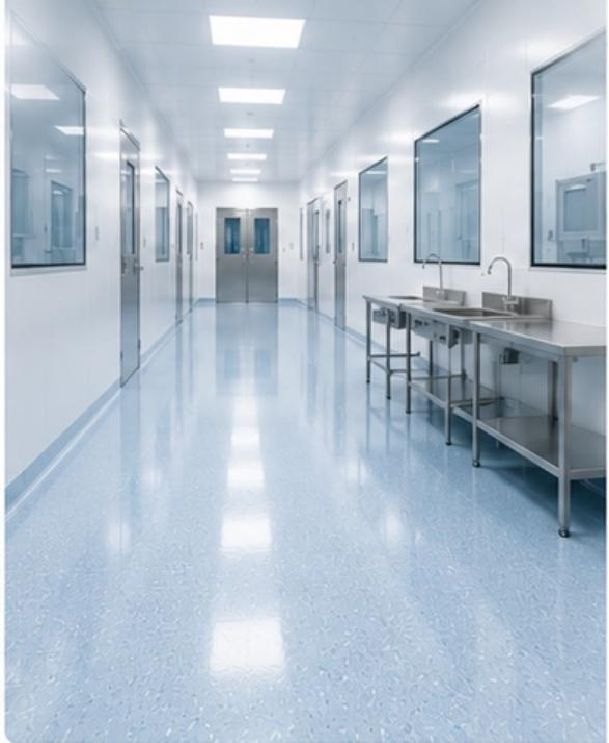
Modern Chinese high-tech fabrication facilities, especially those producing semiconductors, flat-panel displays, and biopharmaceuticals, rely on a delicate balance between laminar airflow and staged pressure differentials to keep particulate contamination at bay. In cleanroom cores, unidirectional laminar flow is typically delivered through high-efficiency particulate air (HEPA) or ultra-low penetration air (ULPA) filter ceilings at velocities between 0.3 and 0.5 meters per second, sweeping particles downward and outward before they can settle on wafers or culture media. The engineering challenge lies not merely in achieving laminar conditions, but in sustaining them across large open bays where equipment heat loads, robotic movements, and operator traffic continuously disturb the air pattern.
Pressure cascades complement the airflow by creating invisible barriers between zones of differing cleanliness. A typical layout might maintain +15 Pa in an ISO Class 4 photolithography area, dropping to +10 Pa in the adjacent Class 5 service chase, then to +5 Pa in the gray room, and finally to ambient pressure outside the fab shell. This ensures that whenever a door opens or a pass-through chamber cycles, air moves from cleaner to less clean spaces, never in reverse. Chinese plant designers increasingly favor fine-tuned cascade steps of 2.5 to 5 Pa rather than abrupt jumps, because smaller differentials reduce door warping, lower fan energy consumption, and make it easier for operators to open heavy cleanroom doors without disrupting the envelope.
Field measurements from newly commissioned fabs in Shanghai, Chengdu, and Hefei reveal a shift toward variable air volume (VAV) systems that monitor particle counts and adjust supply air in real time, rather than running at a constant high airflow. This approach trims energy use by 20–30% while still holding laminar flow integrity during production peaks. However, it demands tighter integration between building management systems and process tools, as a sudden exhaust spike from a wet bench or diffusion furnace can momentarily reverse a pressure cascade if the VAV response lags. Leading Chinese high-tech plants now install fast-acting differential pressure sensors with response times under 0.5 seconds and use model predictive control to anticipate tool exhaust transients, keeping the laminar and pressure architecture robust even during high-intensity manufacturing runs.
The Floor and Wall Materials That Survive Aggressive Cleaning
Porcelain tile rarely flinches when hit with degreasers, steam, or a stiff-bristled scrub brush. Its near-zero absorption rate means bleach solutions and acidic cleaners sit on the surface instead of soaking in, so you can attack grime without worrying about staining or warping. For walls, large-format porcelain panels eliminate most grout lines, leaving fewer crevices where mold and soap scum like to hide. That alone cuts scrubbing time in half.
Epoxy and urethane-based coatings turn ordinary concrete or plywood into a seamless, chemical-resistant shell. These finishes shrug off hot water, solvents, and repeated scrubbing, which is why commercial kitchens and veterinary clinics lean on them. If you need a softer feel underfoot, look at sheet vinyl with a thick wear layer and heat-welded seams. Unlike click-lock planks, it has no gaps for moisture to sneak into, so aggressive mopping with quaternary disinfectants won't cause edge lift or bubbling.
Stainless steel and fiberglass-reinforced plastic (FRP) panels are the quiet workhorses for walls in high-sanitation spaces. They don't chip when a metal scraper is used to remove dried-on residue, and they tolerate pressure washing on low settings. The key isn't just the material itself—it's the installation. Backer board and proper sealants around outlets and corners matter just as much. Otherwise, even the toughest surface fails at the seams after a few months of daily chemical baths.
Semiconductor and Biopharma Scale-Ups Demand Cleaner Air
As semiconductor fabs move from pilot lines to high-volume manufacturing, the cost of a single airborne particle changes from a nuisance to a potential yield killer. Smaller geometries leave no room for even a few nanometers of settled contamination, so air handling systems get reworked with ultra-low penetration filters, tighter pressure cascades, and more aggressive purge cycles. Teams that used to accept weekly particle counts now watch real-time monitors tied to every tool.
Biopharma scale-ups face a parallel shift, but the enemy is not just dust. Clean utilities and HVAC need to control viable organisms, endotoxins, and cross-contamination between batches. A pilot suite might tolerate a brief door opening; a commercial line running multiple products cannot. This pushes facilities toward single-pass air, HEPA terminal housings, and supply/exhaust balancing that keeps corridors and processing rooms in a strict differential pressure hierarchy.
In both sectors, the phrase "cleaner air" stops meaning "more filters" and starts meaning "engineered airflow that matches process risk." That includes managing temperature and humidity stability, reducing static charge on surfaces, and validating recovery times after interventions. Operators who treat air as a raw material—specified, monitored, and released—find that scale-up becomes less about adding square footage and more about protecting every cubic meter inside it.
Fill-Finish Lines Where One Particle Can Halt a Batch
A single stray particle drifting into a vial during fill-finish can trigger a cascade of consequences that no batch release protocol can ignore. Unlike upstream processes where filtration or chromatography might rescue a contaminated lot, the final filling stage leaves no room for correction. Once that particle settles into the liquid, the entire batch—sometimes hundreds of thousands of doses—is judged by a standard that treats one visible speck as a sign of systemic failure. Operators learn to read the air itself: the subtle shifts in laminar flow, the faint electrostatic cling on glass, the way a glove moves too quickly near an open port. Each of these tells a story about whether the line will run clean or grind to a halt for investigation.
The pressure to maintain zero-defect output warps routine decisions in ways outsiders rarely see. A technician might hesitate before adjusting a filling needle, knowing that even a microscopic dislodged particle from a worn gasket could mean re-filtering, re-sterilizing, and losing a day of production. Maintenance schedules get compressed, but not out of negligence—rather from the understanding that every intervention itself introduces new contamination risks. Some facilities have started using real-time particle monitors that feed data back to operators, but the real skill remains human: learning which alarms signal a genuine breach versus a transient spike from someone walking past a critical zone. That distinction only comes from years of standing on the line, watching how a batch behaves when the room is quiet versus when the air handlers are cycling.
When a particle does halt a batch, the aftermath is rarely as simple as discarding the affected units. Investigations pull apart every variable—the lot of stoppers, the humidity in the filling suite, the exact moment a vial left the depyrogenation tunnel. Root cause might point to a cracked filter housing or a flawed cleaning validation, but often the answer is less satisfying: a confluence of small events that no single change can prevent. What separates resilient operations from fragile ones is not the absence of particles but the speed at which teams shift from blame to mitigation. The line stops, the particle is isolated, and the clock starts ticking on a decision that balances patient safety against the brutal economics of a halted batch.
Upgrading Legacy Cleanrooms Without Shutting Down Production
Retrofitting an aging cleanroom while production lines keep running feels like changing a jet engine mid-flight. The trick lies in isolating zones with temporary soft-wall barriers and negative air pressure differentials, so dust from demolition never drifts into active areas. Teams can then swap out ceiling grids, lighting, and HEPA fan filter units in tightly controlled phases, often during scheduled downtime windows that last only a few hours.
What often gets overlooked is the value of running a shadow HVAC loop before cutting over. By pre-installing new ductwork, chillers, and controls alongside the existing system, you give the upgraded air handling units a chance to stabilize humidity and particle counts in a sealed test bay. Only when the data matches the original cleanroom classification do you flip the switch and decommission the legacy equipment.
Equally important is training the maintenance crew on the new monitoring tools weeks in advance. Real-time particle counters and wireless pressure sensors allow them to spot a failing seal or overworked fan before it becomes a contamination event. With that level of visibility, the facility can keep operating at full capacity while the last panels of the old cleanroom are quietly wheeled out the back door.
FAQ
They combine strict ISO class limits with custom airflow design, advanced filtration, and materials that minimize particle shedding. Chinese suppliers often integrate modular wall panels and raised flooring to reach ISO 5 or below while keeping energy use in check.
Semiconductor fabrication, biopharmaceutical production, medical device assembly, and flat panel display manufacturing are the biggest users. Some aerospace and precision optics lines also require the same level of cleanliness for sensitive components.
They use dedicated HVAC systems with chilled water coils, electric or steam humidifiers, and tight sensor networks. The goal is often plus or minus 0.5 degrees Celsius and plus or minus 3 percent relative humidity, depending on the process, with redundancy built in for continuous operation.
HEPA or ULPA filters are standard, often staged with pre-filters and chemical filters. Terminal HEPA units cover the ceiling to maintain laminar flow, and filter integrity is tested with aerosol challenges before handover.
They favor modular sandwich panels with a metal or anti-static coating, joined by sealed gaskets and rounded corners to avoid dust traps. Ceiling grids support fan filter units and lights, while all penetrations are sealed with silicone or specialized boots.
After construction, teams perform airflow velocity tests, particle counts at rest and in operation, filter leak scans, pressure differential checks, and recovery rate tests. Documentation follows ISO 14644 and sometimes EU GMP depending on the sector.
Designers use variable frequency drives on fans, low-pressure-drop filters, and demand-controlled ventilation to cut energy consumption. Some facilities recycle heat from exhaust air and use high-efficiency chillers to lower operating cost without sacrificing cleanliness.
There is growing use of smart sensors for real-time monitoring, modular pods that can be reconfigured quickly, and automation to reduce human-borne contamination. Green building materials and digital twin modeling are also becoming more common in large projects.
Conclusion
In China’s advanced cleanroom sector, classification numbers are just the opening chapter. A facility that meets ISO 5 on paper can still fall short if laminar flow vectors, pressure cascades, and recovery times are not tuned to the actual process. Many high-tech plants now push beyond standard certification, using computational fluid dynamics to fine-tune air patterns around automation clusters and tool exhausts. Floor and wall selections follow the same logic: urethane cement and PVDF-coated panels survive repeated exposure to hydrogen peroxide and quaternary ammonium without micro-cracking, which matters when a single particle can halt a fill-finish line.
The semiconductor and biopharma scale-up wave has raised the stakes further. New fabs and cell therapy suites demand cleaner air not just at rest but during full production, where human movement and robotics create unpredictable eddies. Operators often retrofit legacy cleanrooms by installing mini-environments, revised pressure steps, and localized fan filter units, keeping lines running while gradually lifting the cleanroom class. This phased approach avoids the costly shutdowns that historically slowed expansion, and it reflects a broader shift: Chinese cleanroom engineering now treats airflow, materials, and operational workflow as one continuous risk control system rather than a checklist of isolated features.
Contact Us
Contact Person: Amy Yang
Email: [email protected]
Tel/WhatsApp: 008619330882686
Website: https://www.genopharmatech.com/