

Bespoke 7.3m Giant Fans: Tailored Airflow Solutions for Monumental Spaces
2026-06-19
When ordinary fans simply won't suffice, VINDUSFAN steps into the realm of the extraordinary. Imagine a 7.3-meter giant, handcrafted not just to move air, but to transform entire monumental spaces—cathedrals, atriums, and grand industrial halls—into havens of gentle, whispering breezes. This is bespoke airflow engineering at a scale that defies convention, where every blade curve, every motor, is meticulously tailored to the unique soul of your space. And the story behind it is as captivating as the gentle whoosh it creates.
Engineering Airflow for Spaces That Defy Convention
Designing airflow for unconventional spaces demands a departure from textbook solutions. Standard ductwork patterns and diffuser placements rarely work when ceilings slant at odd angles, walls curve unexpectedly, or open areas blend into semi-enclosed nooks. Instead, we start by mapping the true shape of the room—its thermal load pockets, natural convection paths, and how people actually move through it. This often means using computational fluid dynamics not as a final check, but as a creative tool to probe ideas that no catalog can supply.
In a gallery with a soaring glass atrium, for example, we avoided bulkheads by tucking linear slot diffusers into custom millwork, letting conditioned air wash down the glazing without drafts. For a recording studio carved into an irregular basement, we paired low-velocity fabric ducts with silent return paths that hid within acoustic panels. The trick is treating constraints not as obstacles, but as clues—letting the architecture tell us where to place every vent, so the airflow feels inseparable from the space itself.
Occupants never sense the underlying complexity; they just feel comfortable without knowing why. That invisibility is the goal. It comes from obsessing over details like discharge velocities that match a room’s natural air movement, or carefully balancing pressure zones so doors close softly instead of slamming. When a space defies convention, the airflow design must be equally original—woven into the building’s fabric rather than bolted on afterwards.
When a Standard Fan Simply Won’t Do
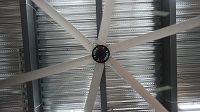
A standard fan can move air, but it often falls short when you need targeted, high-velocity airflow or whisper-quiet operation. In workshops, server rooms, or even during a punishing heatwave, relying on a basic oscillating model just means you're settling for mediocre cooling and constant background noise. The truth is, not all spaces or situations are built the same, and neither should your cooling solution be.
Think about those moments where precision matters: keeping an overheated piece of machinery from shutting down, directing a concentrated breeze across a gym floor, or simply trying to sleep without the rattle and hum of unbalanced blades. A no-frills fan can't adapt to these demands—it’s either on or off, blowing broadly and often inefficiently. When you’re facing stagnant air in a vaulted living room or need to vent fumes from a makeshift studio, the limitations become impossible to ignore.
That’s where engineered airflow steps in. High-velocity floor fans, bladeless designs, or directional air movers ditch the one-speed-fits-all approach and give you control over intensity, direction, and even the sound profile. They’re built for the corners of life where a generic breeze just doesn’t cut it—making the difference between tolerating the heat and actually getting comfortable.
The Art of Moving Air in Monumental Settings
In the silent vastness of a cathedral, the whisper of moving air is a presence felt rather than heard. Mastering that invisible current demands an intimate understanding of pressure gradients and thermal layers. Each column and archway becomes a participant in a quiet choreography, guiding warmth to stone-cold corners without a single rattle or draft. The real skill lies not in overpowering the space with machinery, but in letting the building breathe as though it were a living thing, its lungs the arches and its breath the measured flow that carries the scent of old timber and incense.
Consider the challenge of a concert hall where every note must land on the ear untouched by mechanical hum. Air is coaxed through labyrinthine passages hidden behind ornate plasterwork, emerging at speeds so low it’s more a suggestion than a breeze. Architects and engineers collaborate in a kind of sculptural balancing act: the volume of the room, the expected body heat of a thousand listeners, even the angle of sunlight through stained glass—all are weighed against the need for silence. It’s a discipline where a miscalculation of a few millimeters can turn a whispered promise into an intrusive whistle.
Beyond comfort, the movement of air shapes how we experience monumentality itself. A sudden cool updraft near a towering nave can evoke awe, while a pocket of stillness in a crowded atrium offers respite. These are not accidents but deliberate strokes in an architectural narrative. The best designs blur the line between necessity and poetry, making the passage of air as integral to memory as the stone and light. In the end, the air itself becomes a monument—invisible, transient, yet utterly essential to the story the building tells.
Custom-Crafted Giants for Unforgiving Environments
When the job site laughs at conventional machinery, we answer with machines built from the ground up. These aren’t off-the-shelf models with a few bolt-on upgrades—every frame, seal, and power train is engineered for a specific set of brutal demands. Whether it’s volcanic ash chewing through ordinary filters or salt spray eating unprotected steel, our giants are pieced together with a fanatical focus on material survival.
We spend more time watching how a machine dies than most spend designing. That means placing welds where cracks never start, choosing alloys that laugh off chemical baths, and routing hydraulics so heat never bottlenecks. It’s slow, deliberate work that pays off when a deep-mine hauler runs five years without a breakdown in an environment that regularly kills stock trucks in six months.
There’s no room for generic in places where failure costs lives or sinks projects. Each unit carries a personality shaped by the terrain it owns—some squat and heavy for unstable ground, others long and lean to slip through narrow canyons. What connects them is a refusal to accept that nature sets the limits. We build the exception.
Balancing Power and Poise at 7.3 Meters
At 7.3 meters, the interplay of power and poise becomes an art form. Achieving balance here demands a deep understanding of how force flows through the body, channeling strength without sacrificing grace. Every movement, from the initial launch to the final stance, requires meticulous control—too much aggression and the structure falters; too much restraint and the impact falls flat. It’s a conversation between muscle and intent, where the terrain itself dictates the terms of engagement.
Mastering this distance is about harnessing explosive energy while maintaining an almost serene composure. The body acts as a coiled spring, releasing power exactly when needed, yet the outer expression remains fluid and unhurried. This paradox is what separates the technically proficient from the truly adept—the ability to make extreme physicality look effortless. Breath, timing, and spatial awareness converge into a single, harmonious moment.
Over time, this balance becomes instinctive, a rhythm etched into the nervous system. It’s not about eliminating tension but distributing it so precisely that it becomes invisible. At 7.3 meters, power and poise are not competing forces; they are two halves of the same whole, shaping a performance that resonates long after it’s over.
Designing Silence into Every Revolution
In a world obsessed with noise, the most radical act is often to subtract. Silence isn't an absence—it’s a carefully engineered presence that lets ideas breathe. Every revolution, from the rustle of a page turn to the hum of a server farm, has a quiet core where intention outruns volume. We design for that silence, embedding it like a seed into the soil of disruption, knowing that genuine shifts happen when the world isn’t watching.
This isn’t about muting progress but about tuning the signal-to-noise ratio. When we strip away the gratuitous, the loud, the merely impressive, what remains is a kind of negative space that draws the eye and the mind. It’s the pause between notes that makes music, the white space on a page that makes text legible. In the machinery of change, these intentional gaps are where creativity flares and where users find their own rhythm without being told.
To embed silence into every revolution is to respect the user’s intelligence, to trust that they’ll fill the gaps with meaning. It’s a discipline that runs counter to the impulse to shout. By designing for the unspoken, we build tools that don’t just solve problems but reshape how people think, quietly reordering the world one muffled heartbeat at a time.
FAQ
They're designed for truly immense interiors—think atriums soaring ten stories high, historic cathedrals, aircraft hangars, or expansive museum galleries. If a standard HVAC system struggles to move air evenly across a cavernous space, these fans step in to create gentle, building-wide air currents without the intrusive roar of smaller high-speed units.
It's a modular engineering puzzle. The blades and hub are shipped in sections and assembled on-site by a specialized crew. They often use scaffolding or lift systems, and the mounting structure must be engineered into the building's framework to handle the fan's weight and rotational forces. Installation usually takes a few days, not hours, and requires careful coordination with the building's design team.
Absolutely. The key is physics: a large diameter blade moving at low RPM can displace a huge volume of air using relatively little power. Most models consume between 1 and 2 kilowatts at top speed—comparable to a household hair dryer—while effectively circulating air across thousands of square meters. This often allows facility managers to raise thermostat set points or reduce ducted HVAC reliance, slashing overall energy bills.
That's where bespoke design comes in. Blades can be carved from laminated wood, finished in translucent composites, or even painted to match architectural detailing. Hubs can be shrouded in custom metalwork. The goal is to make the fan feel like a deliberate architectural element—a kinetic sculpture that complements, rather than clashes with, a monumental space.
Properly installed, they're almost silent. The blades turn at a leisurely pace, often below 100 RPM, generating more of a subtle whoosh than a mechanical drone. The motor and gearbox are isolation-mounted to prevent vibration transmission. Many building occupants only notice the air movement, not the fan itself.
Not really. The motors are direct-drive or gearless, so there's minimal wear and tear. Most systems use sealed bearings rated for decades of use. When inspection is needed, integrated service platforms or suspended scaffolding provide safe access. The biggest maintenance task is typically just keeping the blades clean to preserve efficiency and aesthetics.
In some climates, yes—at least partially. They work on the principle of adiabatic cooling: moving air accelerates sweat evaporation, making people feel up to 5°C cooler. For dry climates or well-insulated buildings with high thermal mass, fans often mean the AC doesn't kick in until outdoor temperatures climb much higher. But they're typically used in tandem with other systems, not as a standalone replacement.
Balancing structural integrity with aerodynamic efficiency. At that scale, blade bending and vibration become critical issues. Engineers have to use advanced composite materials or reinforced wood laminates to keep the blades stiff yet light. Hub design must handle enormous torque while remaining sleek—every detail, from blade pitch to winglet shapes, is tuned through computational fluid dynamics testing for that specific building.
Conclusion
In spaces where ceilings soar and architecture pushes limits, standard ventilation simply falls short. Our bespoke 7.3-meter giant fans are engineered to move air through vast volumes with precision—no off‑the‑shelf product could ever match the demands of atria, stadiums, or industrial cathedrals. Every fan starts as a blank sheet, with blade profiles, pitch, and motor characteristics shaped around the unique geometry and thermal profile of the site. This isn’t just scaling up; it’s rethinking airflow from the ground up. The result is a quiet, commanding presence that turns still, oppressive air into gentle, floor‑level comfort without turbulence or dead zones, no matter how unconventional the structure.
Custom‑crafting a 7.3-meter rotor demands a delicate dance between brutal power and ballet‑like poise. Our hubs and blades are built to shrug off relentless heat, humidity, or dust, all while spinning with an efficiency that keeps energy draw surprisingly low. Acoustic modeling ensures each revolution stays whisper‑quiet—vital in memorial halls or performance venues where silence is sacred. From the first CFD simulation to the final on‑site balancing, every detail serves a single purpose: to let the architecture breathe without the machinery ever intruding. These aren’t just fans; they’re invisible partners in preserving the soul of monumental spaces, day in and day out.
Contact Us
Contact Person: Michael Danielsson
Email: [email protected]
Tel/WhatsApp: +1 951 565 7769
Website: https://www.vindusfans.com